

News
One atom makes all the difference: Heat transport through molecules controlled in a targeted manner for the first time
In close collaboration with researchers from the University of Michigan (USA), physicists in Augsburg have succeeded for the first time in proving experimentally and theoretically that heat transport through molecules can change by up to a factor of two through the exchange of a single atom. The study was published in the highly renowned journal Nature Materials.
Invisible magnets for faster IT

Voltage Switches Antiferromagnetic States on Nanosecond Timescales
Physicists at the University of Augsburg together with collaborators from the Budapest University of Technology and Economics and Rutgers University, USA, have successfully switched an antiferromagnetic state in an insulator by voltage pulses, within just a few tens of billionths of a second. Their findings were recently published in Physical Review Letters.?
Breakthrough in Kitaev Materials: control of competing interactions through pressure
Physicists from the University of Augsburg have achieved an important breakthrough in their work with so-called Kitaev materials - a basis for quantum spin liquids. This insight from basic research is important for the development of future technologies. The results, which were obtained at the Chair of Experimental Physics VI, were published in the highly renowned journal Nature Communications.

CHE ranking: good rating for physics and mathematics master's degree programs
The Faculty of Mathematics, Natural Sciences and Technology at the University of Augsburg can draw a positive balance: Its Master's degree courses in Mathematics and Physics have achieved excellent results in the new CHE University Ranking 2024. This nationwide comparison of degree courses and study conditions was published by the Center for Higher Education Development (CHE) in mid-December.

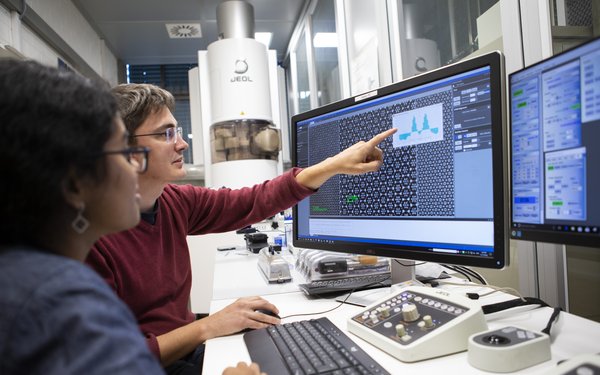
DFG funds Centre for Electron Microscopy at the University of Augsburg

New project researches “potholes” at the edge of space

Machine learning solves complex quantum problems
Due to a new method, artificial neural networks, as used in machine learning, will be able to be trained quicker so as to be able to solve complex problems in quantum mechanics. For example, previously unexplained properties of a special state of matter, the quantum spin liquid, can be calculated, something that has not been possible with any previous method to date. This has been made possible by a new optimisation method developed by the Institute of Physics.

Praise for Augsburg’s bachelor’s degree programmes by CHE Ranking

How life began: A molecular perspective

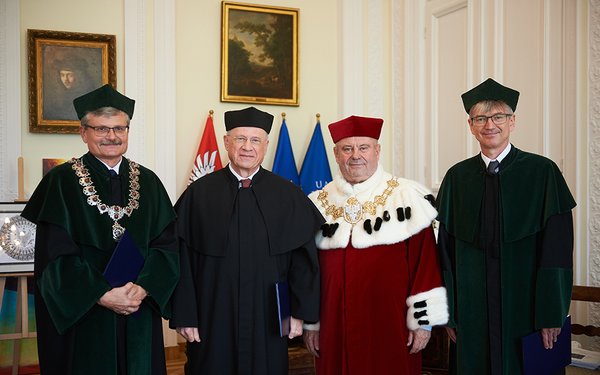
Honorary doctorate for Prof. Dieter Vollhardt
Prof. Dieter Vollhardt was awarded an honorary doctorate by the University of Warsaw last week in recognition of his scientific achievements and longstanding collaboration with theoretical physicists at the University of Warsaw.
New measuring device should improve the development of vaccines
