
Professor for Geoinformatics
The goal of the Geoinformatics Lab is to develop innovative computational methods for modeling, analysing and simulating human geo-spatial behavior. The focus is on
- processes using spatial cognition such as geographic space appropriation, perception and wayfinding
- dynamic complex systems such as multi-modal transportation networks
Such human-environment interactions may best be understood using a bottom-up perspective, ie. through implementing generative models while at the same time corroborating the usefulness of the models by analysing using a top-down perspective. We are currently exploring several methodologies, i.e., we work with agent-based modelling, geosimulation, classical spatio-temporal analysis, GIS models and extensions as well as GeoAI-methods.
News
IJGIS Paper published
Eva Nuhn, Mona Maetze, and Sabine Timpf published an article in the International Journal of Geographical Information Science.
?
The publication is titled "Sounds in the city: on the utility of acoustic landmarks" and presents the result of a sound study in the inner city of Augsburg.
?
The article is available here:
[Geoinformatics]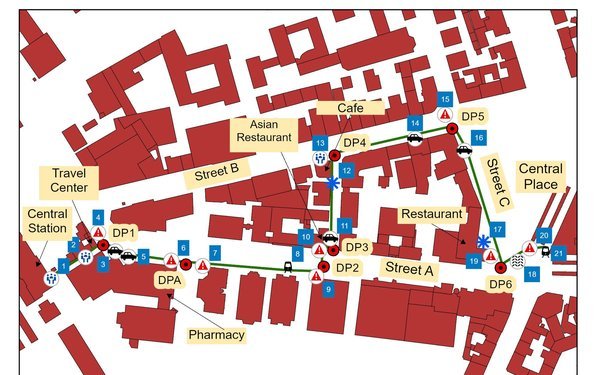
Realistic Agent Behaviour based on Concurrent Process Architectures
?
New publication and presentation at the EUMAS conference in Bukarest, Sept 2025. The publication is titled "Realistic Agent Behaviour based on Concurrent Process Architectures - Modelling Human Navigation" and is the result of a collaboration between Prof. Sabine Timpf and Prof. Franziska Klügl from the Universitet ?rebro in Sweden.
[Geoinformatics]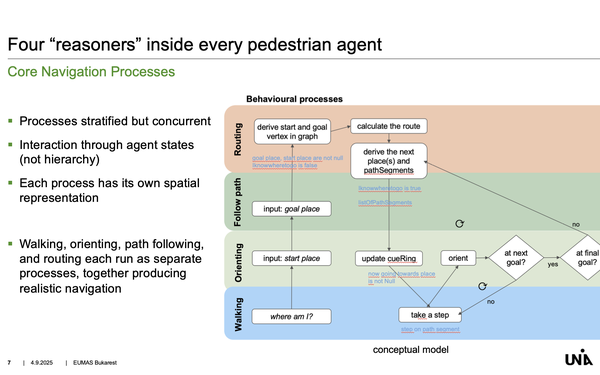
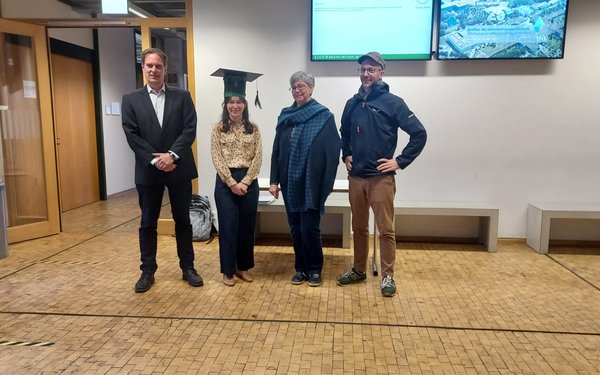
Congratulations Dr. Ismayilova
?