

Green Hospital
Improving Sustainability in Hospitals:
Researchers at the Centre for Climate Resilience are examining energy efficiency, environmental protection, and social factors in hospitals as part of the ongoing development of “Green HospitalPLUS”
?
About the Project
On behalf of the Bavarian State Ministry of Health and Care, the team at the Centre for Climate Resilience at the University of Augsburg is developing practical indicators that can be used to systematically measure and evaluate the sustainability of healthcare facilities. The project, which is scheduled to run for three years, is funded by the Free State of Bavaria with 1.8 million euros.
The Free State of Bavaria aims to become climate-neutral by 2040. The healthcare sector plays an important role in this effort, as it is responsible for nearly five percent of the state’s greenhouse gas emissions. Already in 2011, the Bavarian State Ministry of Health and Care contributed to the energy transition in the Free State through the Green Hospital Initiative, which aimed to improve the energy efficiency of hospitals. This initiative has since been expanded under the label “Green HospitalPLUS” to include the dimensions of “environment” and “people.”
The new Augsburg research project builds on this and aims to further develop the initiative into a holistic, indicator-based sustainability tool for Bavarian hospitals.
?
You can learn more about the Green HospitalPLUS initiative here.
Forschungsansatz und Ablauf
The study examines the sustainability efforts of Bavarian hospitals with regard to the pillars of “Environment,” “Infrastructure & Energy,” “People,” “Organization & Administration,” and “Security of Supply.” The project focuses on creating a comprehensive, indicator-based management system that enables users to assess and implement sustainability and security of supply in hospitals. Sustainability has not only ecological goals but also economic and social dimensions. Security of supply aims not only at hospitals’ ability to cope with sudden changes (e.g., pandemics, supply shortages) but also at their ability to adapt to long-term changes such as demographic shifts.
?
?
?
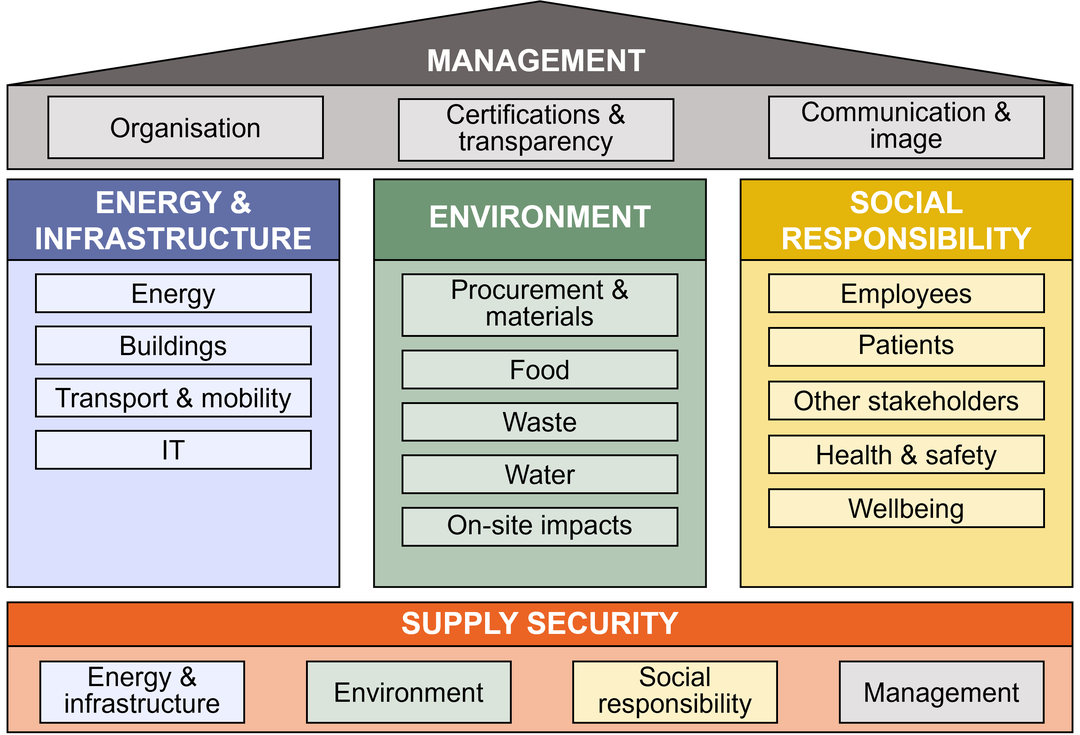
The research project is divided into the following work packages:
?
Publications
First publication as part of the “Green Hospital Plus” project:
?
Hospitals currently face the challenge of achieving sustainable and resilient transformations. The focus here is on measuring, monitoring, and reporting on sustainability performance. There is no consensus in the scientific literature on how and with which indicators the environmental and social sustainability of hospitals should be assessed, nor on which aspects should be considered; furthermore, terminology and categories are not standardized. Against this backdrop, researchers at the CCR led by Dr. Andrea Thorenz and Prof. Dr. Axel Tuma published the article “Indicator-based environmental and social sustainability assessment of hospitals: A literature review” in the Journal of Cleaner Production as part of the “Green Hospital Plus” project funded by the Bavarian State Ministry of Health, Care, and Prevention. This article provides an overview of the understanding of sustainability in the relevant literature and the wide range of sustainability indicators proposed therein, while also deriving a “best practice” taxonomy for indicator-based sustainability assessments of hospitals
?
The article can be accessed here.
?
?
Further publication on this topic
?
Central Sterile Services Departments (CSSDs) play a critical role in hospital operations, yet they have a significant environmental footprint due to high energy, water, and resource consumption. Operational goals, such as the rapid processing of sterile equipment, often conflict directly with environmental objectives. Against this background, an interdisciplinary team of researchers from the CCR, the Faculty of Business and Economics, and the Technical University of Denmark (DTU) has developed an optimization model that supports decision-making in CSSDs from both operational and environmental perspectives. Using German and Danish Life Cycle Assessment (LCA) data, the study highlights potential improvements and identifies viable trade-offs between operational efficiency and environmental impact. The findings provide both detailed approaches for process optimization and broader insights for the sustainable transformation of hospital operations as a whole.
?
The article is currently (as of April 2026) being revised for publication in the management science journal “Omega.”
?
Contact and representatives
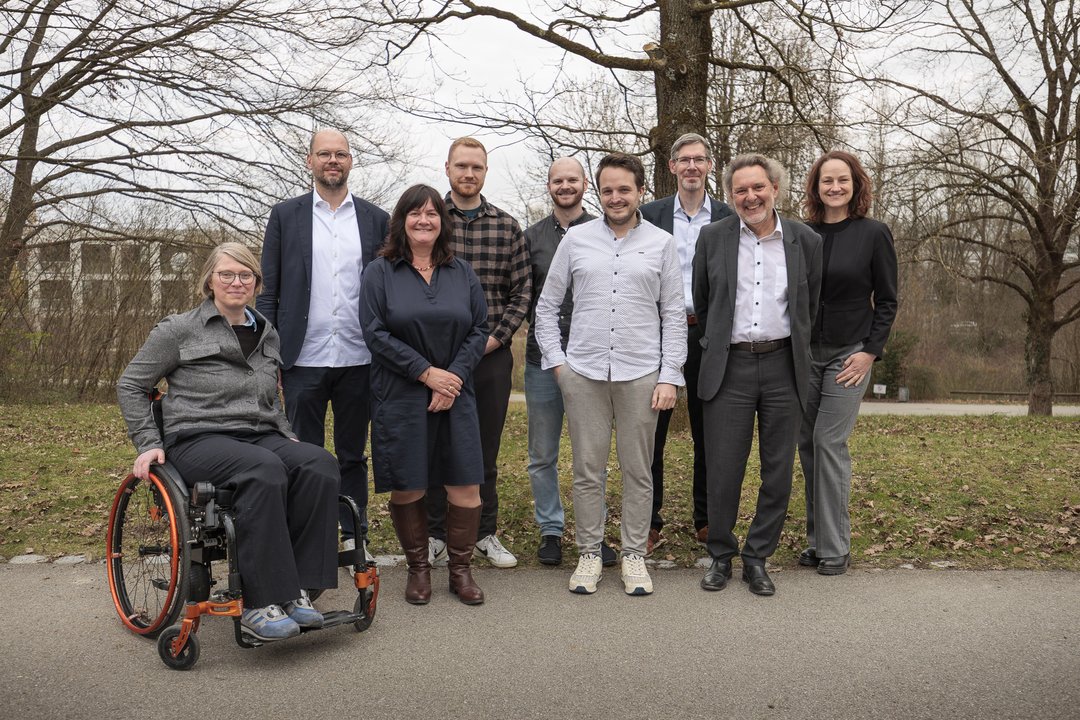
The following members of the Center for Climate Resilience at the University of Augsburg are participating in the three-year project:
?
- Resource Lab at the University of Augsburg, represented by Dr. Thorenz (coordination)
- Prof. Dr. Helena Bilandzic and Dr. Anja Kalch (Health and Environmental Communication Working Group; Chair of Communication Sciences with a focus on reception and impact research)
- Prof. Dr. Jens Brunner (Chair of Health Care Operations/Health Information Management)
- Prof. Dr. Manuel Ostermeier (Chair of Resilient Operations)
- Prof. Dr. Axel Tuma (official director, Chair of Production & Supply Chain Management)
- Prof. Dr. Marcus Wagner (Chair of Innovation and Sustainable Management)
- Phone: +49 821 598-3948
“By further developing our Green HospitalPLUS initiative, we are advancing climate protection in Bavarian hospitals.
I am very pleased that the Center for Climate Resilience is supporting us on this journey with its scientific expertise.”
?
?
Minister of Health Klaus Holetschek?
?
?
?
?
?
“With its diverse range of disciplines and interdisciplinary networks, our Center for Climate Resilience possesses the right expertise to provide constructive and comprehensive support for the Green HospitalPLUS initiative.”
?
?
Prof. Dr. Sabine Doering-Manteuffel, President of the University of Augsburg
“With the results from Augsburg, we are enabling an assessment of hospital sustainability and developing proposals for scientifically sound and practice-oriented improvement measures. In this way, we are helping to further advance the Green HospitalPLUS initiative.”
?
Prof. Dr. Axel Tuma, Project Leader and Deputy Director of the ZfK